Monthly Archives: 8月 2015

Interview Cont’d

20_large


———“If you had to categorize fermented food, what would you base it on? What would be the key player here?”

Okay, that’d be hishio, which is the starter of soy sauce and miso. You put together mame koji (bean koji) and mugi koji (wheat koji) in 1:1 ratio, and add soy sauce and water and leave the mixture to ferment.
(Fermentation cuisine has categories that are)
Tasting fermented seasonings with decomposing abilities, such as hishio.
Marinating in fermented seasonings and eating. This is for vegetables, sashimi, and the such.
Marinating in fermented seasonings and grilling. Meat and fish are often eaten this way.
Marinating in fermented seasonings and cooking it in soup. Fish ara (head and bony parts of fish) and the such can be used for this.
Marinating in fermented seasonings and frying.
And (even if you don’t marinate,) if you use real fermented seasonings in your cooking such as soy sauce, miso, mirin, vinegar, and sake from legitimate storehouses, that counts as fermented food I guess.

105_large

———“If you had to categorize them now based on what you marinate your food in, what would that be like?”

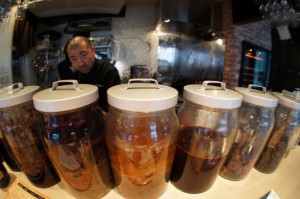
Even the mixture of peanut butter and hishio can be used as a pickling bed. That means there can be tens of millions of variations. The two things I use the most as a pickling bed at my restaurant are hishio and amazake. Of course, I use soy sauce, sake, and mirin as seasonings, but as pickling beds, probably hishio is the best. It has a quite high ability to break down ingredients. Also the proportion of glutamine acid to inosinic acid is very high, which is a major difference from miso. You can be sure that your final products always have more glutamic acids than inocinic acids. Food tastes better that way, and you can preserve it longer.

Decomposition by koji involves many factors such as salt, heat, microorganisms, adding water, and pressure. Japanese koji’s ability to break down reaches far beyond what heat can do. Rice porridge, for example, is made of rice and water just like amazake, but no matter how long you cook it, it doesn’t gain sweetness on its own. With koji mold in it, however, it will turn into amazake and become sweet.

As starches get broken down into smaller molecules, they eventually become glucose, which is their smallest form. The food won’t have the sweetness until this stage, and you can’t reach that with heat alone. When you let koji do its work with ingredients before you cook them, whether with hishio, miso, soy sauce, or amazake, it will give you flavors unattainable in any other way.  Take fish ara for example; without koji you can cook it in the soup for 100 hours and still not have the great flavor. That’s one of the great things about fermentation.


Interview Cont’d

46_large


———“That must have been a quite challenging change in your career. “

You’re right. And I had to study on my own. I still learn new information every month. Now I have much better estimates of various aspects of cooking than before.  My cooking is much more precise now that I can control umami elements with the appropriate temperature, oxygen, acidity, and alcohol percentage.  Although, since fermentation is about living things, it doesn’t always go smoothly as planned.

There were so many questions I had had for a long time as a cook.  I would ask my master chef and he would say, “I don’t know. It’s always been this way.” For example, I’ve had this master chef who always let his ponzu sauce sit in the room temperature for a year before using it. Chefs in Tohoku area usually store their miso in the room temperature. They say that it’s been always known that the refrigerator makes miso taste bad. When mackerel is not fresh enough to be eaten raw, they use it for vinegared mackerel. The same thing with kelp-wrapped sea bream. All these why’s were answered as I studied about fermentation and microorganisms. It was like a light bulb shooting sparks over my head all the time. Every question I had had for twenty years was answered.
 

37_large

——— “When people didn’t have refrigerators they dried their food or marinated it in salt, alcohol, or oil to prevent decay. Maybe that is related to fermentation, too?”

It is related because decay is a kind of fermentation. Dried food has the highest preserving capacity. If you marinate in acidic liquid (e.g. vinegar) it gives food better preservation because putrid bacteria don’t like acidity, so they don’t go into food.

E coli. O157 is different. It’s a bacterium that can go into acidic environments.  For bacteria, being in oil is like being in outer space, they can live there but can do nothing, which leads to better preservation.  Microorganisms cannot live when the salt level is higher than that in their natural habitats, so marinating in salt also leads to better preservation. There is a certain order for microorganisms to function in liquid. First, nitrate-reducing bacteria are activated, followed by koji, then plant-based lactic acid bacteria, and finally yeast; now it’s become alcohol. Plant-based lactic acid bacteria are highly acidic, so when there is sugar it keeps creating acid, reducing the liquid’s pH and making it acidic. This makes it impossible for putrid bacteria to enter. Thus, you can have better preservation. Alcohol is the same. In alcohol, microorganisms cannot move at all. So when the alcohol content is 10% to 15% and above, microorganisms die. This shows there is an intricate power balance between bacteria.

So before, I just knew formulas and their outcomes but didn’t know why the formulas work. Now that I’ve studied about fermentation, I know why they work, too. I feel like I’m substantiating Japanese cuisine.
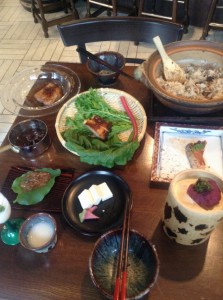
 

200_large
———“Can you tell us a little bit about dashi?”

For dashi, whether you use hard or soft water makes a huge difference.

If you’re in the Kansai area the water is soft, and with that you can make dashi really fast. In Kanto or Tohoku, however, the water is hard, and you will need more than double the time just to make kelp dashi. In Milan it even takes a lot longer.  We say we “take” dashi, but what it actually is is extracting umami from dried food through heat breakdown. There is no other way to get umami than taking time. Within Japan, we have two different philosophies regarding glutamine acid (umami) between the Kansai area and the Kanto and Tohoku areas. People don’t want their dashi dark in Kansai, but in Kanto and Tohoku, they like dark dashi.

———“Some food-science savvy people may think of the Maillard reaction (browning reaction) when they see food darkening. Can you tell us about the Maillard reaction please?”

It is a chemical reaction between amino acids and sugar. Amino acids themselves are dark brown, and when this color becomes prominent on the surface, it’s called  the Maillard reaction. A good example is when banana skins turn dark and eventually black. With bananas, however, it’s only the skin that becomes black. The inside never becomes black but does become brown because of the oxidation of polyphenol. The Maillard reaction can be seen in coffee, too. When you get your toast burned, it’s showing the final stage of the Maillard reaction accelerated by heat. When you grill regular salted salmon and miso-covered salmon, the miso covered one gets burned much more easily. It’s because amino acids are on the surface taking the heat. That’s why in the summer, miso and soy sauce change color suddenly.

When food has a lot of amino acids, the Maillard reaction comes out more strongly. That means you can actually visually recognize the umami in the food as long as it’s properly fermented. The darker miso and soy sauce are, the stronger the umami in them is. The same goes with mirin (sweet cooking rice wine). Mirin is made from shochu, (Japanese distilled spirit) mochi rice, and kome koji (rice malt). Mochi rice has protein, which gets broken down and becomes amino acids, causing the Maillard reaction.

Regular vinegar is made from white rice, and it doesn’t cause the Maillard reaction because white rice only contains starches. Black vinegar on the other hand is made from brown rice so it does causes the Maillard reaction. That’s why it is black.

The Maillard reaction is also what makes natto brown. Different soy products require soy to go through different processes. Typically there is the immersion process where you immerse soy in water, and then there is the steaming/boiling process where you add heat to the soy. If you want to make white miso, you don’t want the Maillard reaction. So, you need to extend the immersion process to about 16 hours in order for all soluble protein of the soy to come out to the water and then boil. Now the Maillard reaction will happen only to the soup, but not to the miso made from the soy. This is how you make white miso.  If you want to make dark miso, you can shorten the immersion down to three hours and steam the soy for about twenty hours. This way you can have the Maillard reaction and the soy turns brown. With this you can make dark miso.

Chopped natto is always light-toned, right? That’s because they chop dried soybeans before they immerse them in water to let go of their proteins. Thus, no Maillard reaction, and white natto. But if you compare regular natto with chopped natto, chopped natto has much less nutrients.
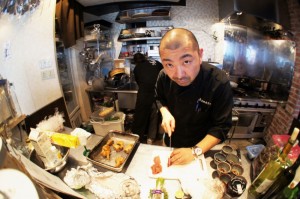
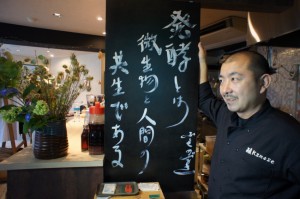
 

Interview : Mr.Fushiki


144_large


———“What does fermented food mean to you, Mr. Fushiki?”

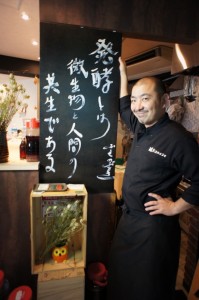
To Japanese people, I believe that fermentation is the symbiosis between humans and microorganisms. I think in fermented food you can include food seasoned with certain fermented ingredients, too. The very essence of fermented food is to have microorganisms break down ingredients ahead of time before you cook them, or in some recipes the fermented ingredients are offered as is.


———“When people hear the word fermentation, they think of fermented seasonings such as miso and soy sauce, or fermented ingredients such as natto (fermented soybeans) and umeboshi (pickled plum). When you say fermented food, however, can I think of it as something like food marinated in miso or soy sauce?”

*Miso … salty, fermented soybean paste used for soup, spread, pickling, etc.

That’s right. But the important point here is that the marinating liquid has to contain microorganisms that have enzymes with the ability to break down ingredients. If you marinate ingredients in liquid without them, it might help you preserve food longer, but it is not fermentation. By marinating with liquid with decomposing enzymes, for example, proteins are broken down into amino acids, starches are broken down into glucose, or fats are broken down into fatty acids.  Microorganisms break down ingredients into smaller molecules. Then we eat the food. Now this is fermented food.

This process of decomposing will not happen if you use general miso or soy sauce that you buy at supermarkets, because they typically contain no enzymes or microorganisms. Microorganisms are decomposers, and they decompose things using enzymes that are made of proteins so they can live. We use this to our benefit.
If you marinate food with miso that has active fermentation going on, proteins and fats in the food will be decomposed.  Now, if you eat food that didn’t go through this such as regular grilled salmon, you will have to do the decomposing of all these things yourself in your body. With fermented food, it is all done ahead of time, so it’s energy efficient and very good for you.

Also, it’s hard for the decomposed ingredients to accumulate in your body because they are now smaller molecules. If you can’t properly break down proteins and fats in your body, it can lead to modern-day illnesses such as allergies and atopic eczema. With fermented food, proteins and fats are broken down in advance, so it’s very good for you. Children with wheat allergy can eat Hishio or wheat miso and have no allergic reaction.

Fermented food is different from rotten food and it poses no harm to human body, but if the fermentation is overdone, you wouldn’t want to taste it. My restaurant has 51-year-old miso. Of course it’s edible, but it smells like a horse stable. It’s like maturation of wine.

If left unattended, alcohol turns into vinegar. Without salt in it, acetic acid bacteria will grow and turn the alcohol into vinegar. Distilled alcohol never turns into vinegar. If acetic acid bacteria are added to wine, it will become wine vinegar, and eventually after a while it will become balsamic vinegar. Japanese sake with acetic acid bacteria will become rice vinegar. Apple cider with the same bacteria will become apple vinegar. You can grow acetic acid bacteria in beer but it doesn’t taste good, so I don’t do that.

The amino acids from decomposed protein contain umami; if the protein is plant-based you get glutamic acid, with animal-based protein you get inosinic acid, and from fungi you get guanylic acid. These are the three major umami ingredients, and the microorganism that can generate them exists basically only in Japan. It’s a mold called koji. (aspergillus)


136_large

———“I understand before you focused on fermented food you used to cook mainly Italian and Japanese. What made you decide to work with fermented food?“

It was actually a son of a miso storehouse who gave me his amazake and hishio. As soon as I tasted them, I intuitively knew it would taste great if I marinated salmon in them. When I tried that idea, it tasted much better than I had expected. This caught me by surprise because, as a chef with over two decades of experience, I thought my guesses were pretty good when it comes to taste, but this time my guess was off. Then I started researching and found out about various roles microorganisms and enzymes play.

Before that, when I heard the word enzyme all I could think of was laundry detergents. As I studied more about this, I came to the conclusion that miso and soy sauce are living things. I was quite embarrassed as a professional chef, by how I always thought they were nothing more than ordinary condiments you could get from stores.

Then I realized there must be a lot of chefs who don’t know about this in Japan. Currently my students have been mainly housewives, but my biggest aspiration is to teach other professional chefs about this. I wanted to get them to revisit the important basics. That’s what I had in mind when I first started.